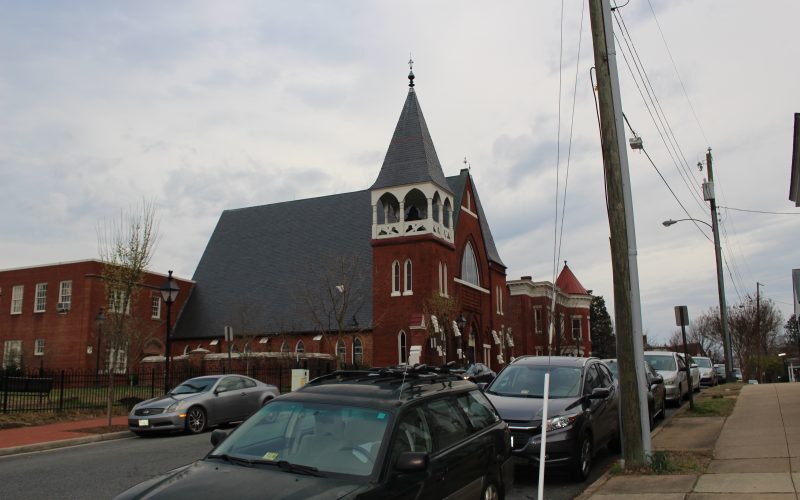
Fredericksburg United Methodist Church
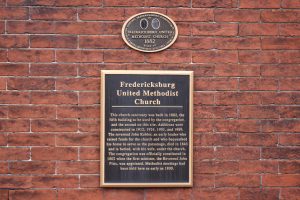
Inscription:
This church sanctuary was built in 1882, the fifth building to be used by the congregation, and the second on this site. Additions were constructed in 1912, 1924, 1951, and 1989. The Reverend John Kobler, an early leader who raised funds for the church and bequeathed his home to serve as the parsonage, died in 1843 and is buried, with his wife, under the church. The congregation was officially constituted in 1802 when the first minister, the Reverend John Pitts, was appointed. Methodist meetings had been held here as early as 1800.
Research:

The Methodist denomination was introduced to Fredericksburg in the late eighteenth century by Francis Ashbury. Ashburg traveled 200,000 miles throughout Virginia spreading the gospel (1).
The original location of a Methodist church in Fredericksburg was erected in 1801 on George Street. The building was only used for four decades because the congregation rapidly grew to be too big (2).
Father John and Mary Kobler were leaders of the Protestant Methodist community in Fredericksburg and encouraged its continued growth through church discipleship. Father Kobler ministered as the local Methodist preacher for over half a century (3).
By 1841, the congregation that the Kobler’s helped cultivate moved to Hanover Street to a newly built brick church. Kobler died in 1843 and was buried beneath the pulpit of the Hanover Street Church (4). As the Civil War approached, the congregation split due to differing views on slavery in 1848 and considered themselves either Northern or Southern Methodists. The Southern Methodists created the Methodist Episcopal Church South (5). The Southern Methodists held their church services in the second story of the town hall and later in 1852 they moved to the South corner of George and Charles streets (6). The Northern Methodists continued to worship on Hanover Street until the outbreak of the Civil War (7).
The Northen Methodist Church failed to last as long as it could of due to the ferocity of the Civil War and its direct impact on Fredericksburg. The church experienced major war damage while the Methodist Episcopal South somehow managed to avoid significant damage (8).
During the period of Reconstruction, the congregation experienced continuous growth. In 1882, the war-torn church on Hanover Street was taken down and a new church was put in its place (9). The new church is still standing today and has gone through various renovations throughout its lifetime in order to preserve it.
The Fredericksburg Methodist Church was the first Methodist church in Virginia to become integrated in 1963 (10). With its storied past and massive mark on Fredericksburg, the Fredericksburg United Methodist Church continues to be a popular place of worship and has a membership totaling 2,500 people (11).
Featured Image:
Lakelyn Wiley, “Fredericksburg United Methodist Church in Fredericksburg, Virginia,” 2018.
(1) “Francis Ashbury and the Shape of American Methodism,” The United Methodist Church, http://www.gcah.org/history/asbury, (accessed April 1, 2018).
(2) “Our History,” Fredericksburg United Methodist Church,http://fumcva.org/about/, (accessed April 1, 2018).
(3) S.J. Quinn, The History of Fredericksburg, Virginia, (Richmond, VA: Hermitage Press, 1908), ebook http://www.gutenberg.org/files/41597/41597-h/41597-h.htm#Page_211, 211 (accessed April 1, 2018).
(4) Ibid.
(5) “Our History.”
(6) Quinn, 211.
(7) Ibid.
(8) “Our History.”
(9) Ibid.
(10) Ibid.
(11) Ibid.
(12) Jacques Reich, “Portrait Drawing of Francis Asbury, American Methodist leader,”Appletons’ Cyclopædia of American Biography, 1900.
(13) Lakelyn Wiley, “Fredericksburg United Methodist Church,” 2018.