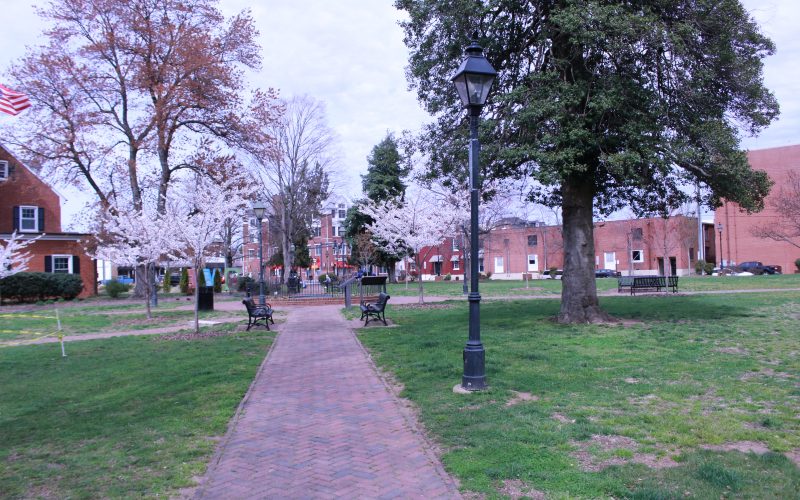
From Burying Ground to Park
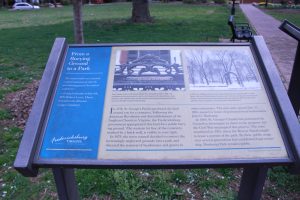
Inscription:
In 1774, St. George’s Parish purchased the land around you for a cemetery. Following the American Revolution and disestablishment of the Anglican Church in Virginia, the Fredericksburg government appropriated this land for a public burying ground. The western lot line of the cemetery, marked by a brick wall, is visible to your right. In 1875, the town council decided to convert the increasingly neglected grounds into a park and directed the removal of headstones and graves to other cemeteries. The new park opened July 12, 1881, named in honor of prominent local businessman John G. Hurkamp. In 1860, St. George’s Church had petitioned the Council to investigate its claim to the property, but the Civil War interrupted this process. The issue resurfaced in 1953 when the Rescue Squad sought to lease a portion of the park. By then, public usage over several generations had established legal ownership. Hurkamp Park remains public.
Research:
St. George’s Parish began construction of the first church in Fredericksburg in 1732 and completed it in 1753. A steeple, bell, and gallery were added in 1759. While the building was effective in its formative years, it could not house the number of members that it wanted to and the Vestry of St. George’s parish moved to buy more land (1). The church had issues with not only allocating funds to

enclose their land but also to expand the property to facilitate more graves and build a new church. The church then petitioned the state and their request for more land was granted. They were given permission to use the backside of their property on Caroline Street but the church was told that they had to obtain another plot in another location (2).
St. George’s parish purchased the land from Fielding Lewis that is enclosed by William, Prince, Edward and George Streets (3). The Parish’s aim was to erect a new church “when thought convenient” (4). The city did not want the entire plot to be owned by the church so they petitioned to own the property in cooperation with the city.
A new church would not be erected because the church lacked the funds so the city decided to consider the site the “new burying ground” and from 1787-1853 the site was known as the “cooperation burying ground” (5).
In 1802, the city complained about the burial ground being “irregular” and an obstruction”. Apparently, because of a lack of room and jurisdiction for where the dead could be buried, there were bodies buried in the streets (6). This was not only a problem near present-day Hukamp park but near many of the burial grounds around town.
In 1815, St. George’s church made the decision to rebuild their new church on top of the existing site. However, the city encouraged them to use the cooperation burying ground as their cemetery (7).
The church did not use the site because the burial ground was far was well-maintained and the headstones and landscape were wildly unkempt. Further,
without a barrier to the grounds, hogs roamed free on the property (8). They petitioned the council to gain more rights to the cemetery but it was tabled and they were unable to have control of the graveyard (9).
In the 1870s, John Hurkamp, a German immigrant, and owner of the city tannery led the effort in cleaning up the burial ground and converting it into a park. Hurkamp served on the city council and helped manage the property and even contributed the money to erect a wrought iron fence around the area to keep the pigs out. The park was named and dedicated to Hurkamp in 1881 (10).
Today, the park, now known as “City Park” is home to the city farmers market and is the located of the “Love” art installation located in the upper corner near Williams Street (11).
Featured Image:
Lakelyn Wiley, “Hurkamp Park in Fredericksburg, Virginia,” 2018.
(1) “St. George’s Church located in Hurkamp Park?,” St. George’s History, http://history.churchsp.org/st-georges-church-located-in-hurkamp-park/, (accessed April 5, 2018).
(2) Ibid.
(3) Ibid.
(4) ibid.
(5) ibid.
(6) S.J. Quinn, The History of the City of Fredericksburg, (Richmond, VA: Hermitage Press, Inc.), 132. http://www.gutenberg.org/files/41597/41597-h/41597-h.htm#Page_211, (accessed April 5, 2018).
(7) “St. George’s Church Located in Hurkamp Park?.”
(8) Fredericksburg Area Tourism Department, “Walk Through History…Hanover Street,” Central Rappahannock Regional Library, http://www.librarypoint.org/walk_through_history_hanover_street, (accessed April 5, 2018).
(9) “St. George’s Church Located in Hurkamp Park?.”
(10)Betty Hayden Snider and Cathy Jett, “People Behind the Names,” Fredericksburg, http://www.fredericksburg.com/local/people-behind-the-names/article_c0beb14a-153e-5b16-a4b5-05dbb1516125.html, (accessed April 5, 2018).
(11) “Hurkamp Park,” Fredericksburg Timeless, https://www.visitfred.com/listings/outdoor-adventures/hiking-walking/hurkamp-park, (accessed April 5, 2018).
(12) “St. George’s Episcopal Church and Cemetery Fredericksburg, Virginia,” Historic Wanderings, https://historicwanderings.blogspot.com/2013/02/st-george-episcopal-church-cemetery.html, (accessed May 1, 2018).
(13) Lakelyn Wiley, “Hurkamp Park–Present Day,” 2018.