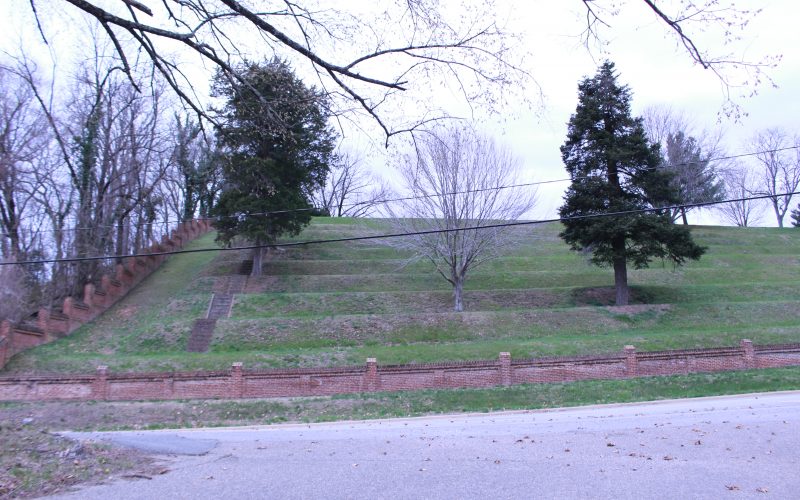
Fredericksburg National Cemetery
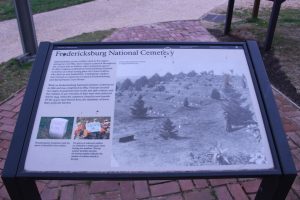
Inscription:
Approximately 20,000 soldiers died in this region during the Civil War, their remains scattered throughout the countryside in shallow, often unmarked, graves. In 1865 Congress established Fredericksburg National Cemetery as a final resting place for Union soldiers who died on area battlefields. Confederate soldiers were buried in cemeteries located at Fredericksburg and Spotsylvania Court House. Work on Fredericksburg National Cemetery commenced in 1866 and was completed in 1869. Veterans erected two major monuments here in the late 19th century, and the remains of 300 veterans of later wars were interred before 1945 when the cemetery closed to new burials. Of the 15,300 men buried here, the identities of fewer than 3,000 are known.
Research:

The Fredericksburg National Cemetary was established immediately following the conclusion of the Civil War in 1865. The site was added to the National Register for Historic Places on October 15, 1966. According to the National Park Service Records, the cemetery has over 15,000 Union soldiers who died in battles in Fredericksburg and Spotsylvania buried here (1). The park cares for not only soldier’s graves, but also historic buildings such as Chatham Manor, Salem Chruch, Ellwood Manor, and the house where Stonewall Jackson died (2).
The four battles that contributed to the carnage are Fredericksburg, Chancellorsville, Wilderness, and Spotsylvania Court House. There were more than 100,000 deaths within a 20-mile radius of Fredericksburg (3).
Following the battles, the dead had been quickly buried in shallow unmarked and/or poorly marked graves. In June 1865, Brevet Major James M. Moore and a company of men searched for the bodies of soldiers to ensure a semi-proper burial (4). Moore and his men buried over 15,000 skeletons of known and unknown soldiers (5).
However, the job was so large that they missed many of the bodies that dotted the landscape of Spotsylvania and Fredericksburg’s battlefields (6). In response, Congress moved to establish the national cemetery in Fredericksburg to provide a proper final resting place for the Union soldiers who had died there (7). The location that was chosen for construction of the cemetery, Marye’s Heights, is the site where most of the Union soldiers died during the Battle of Fredericksburg on December 13, 1862 (8).
Construction of the site began in May 1866 and the burial process commenced. However, by June most of the work performed on the cemetery’s were done by paid former slaves, Irish immigrants, and Confederate veterans (9). Because of its location and landscape, the gravesite planning followed the contours of the terrain(10). The work proved difficult and required disinterring the dead from the battlefield and reinterring them. Many of the bodies were on sections of the battlefields that were miles away from the new burial ground (11).
After the site was completed, 15, 243 Union soldiers were laid to rest with only 2, 473 men identified (about 20%)(12). Seven out of every eight burial plots are occupied by unknown soldiers and many of the plots have multiple soldiers buried there for lack of space(13). The men identified typically had some form of identification or were originally laid to rest in marked graves on the battlefields (14) (15).
Bodies were found for decades following the Civil War. The last bodies interred in the cemetery occurred in 1868 and after that, the owners of the cemetery buried other bodies in various cemeteries around Fredericksburg(15).The national cemeteries did open up some plots to the spouses and families of the men who died and even took internments for the veterans of the Spanish American War, World War I, and World War II up until 1945 (16).
The Confederate Soldiers who died during the Civil War were interred in designated Confederate Cemeteries in Fredericksburg and Spotsylvania (17).
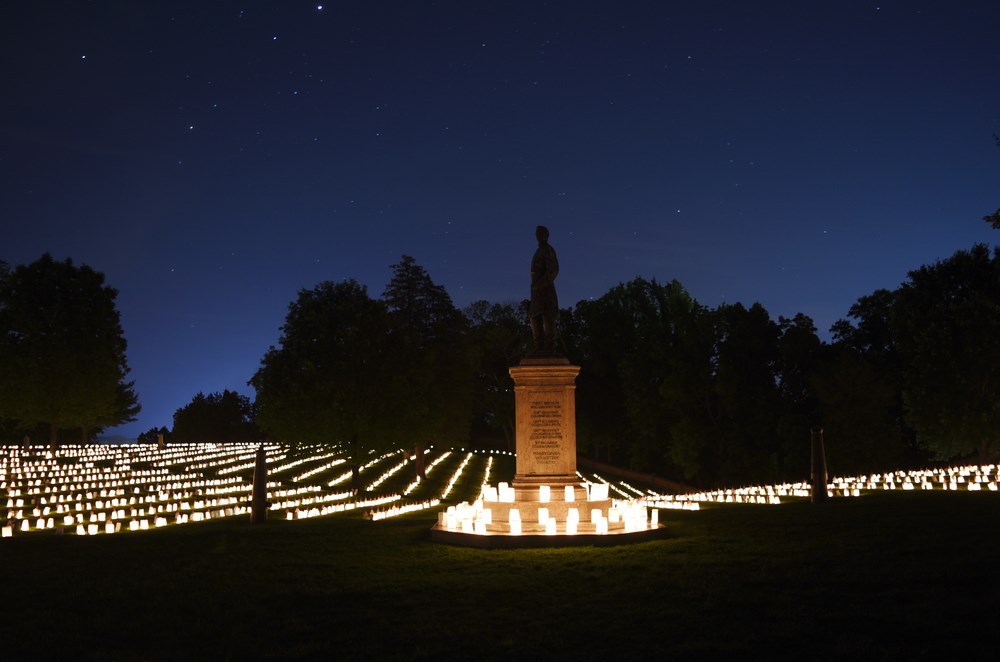
On the Saturday of Memorial Day weekend, there is an annual illumination of the cemetery. The cemetery is lit up with 15,000 candles; one to honor every soldier buried there (18).This event is free to the public and allows all to pay tribute to soldiers who paid the ultimate sacrifice for the United States (19).
Featured Image:
Lakelyn Wiley, “Fredericksburg National Cemetery in Fredericksburg, Virginia,” 2018.
(1) National Park Service, “Fredericksburg National Cemetery, Fredericksburg, Virginia”,https://www.nps.gov/nr/travel/national_cemeteries/virginia/Fredericksburg_National_Cemetery.html (accessed April 1, 2018).
(2) Ibid.
(3) Ibid.
(4)”History of the Fredericksburg National Cemetery.” Fredericksburg National Cemetary. https://fredericksburgnationalcemetery.omeka.net/history, (accessed April 1, 2018.
(5) Ibid.
(6) Ibid.
(7) National Park Service, “Fredericksburg National Cemetery.”
(8) Ibid.
(9) “History of Fredericksburg National Cemetery.”
(10) Ibid.
(11) Ibid.
(12) National Park Service, “Fredericksburg National Cemetery.”
(13) “History of Fredericksburg National Cemetery.”
(14)”Memorial Day Through the Years: Remembering the Fallen,” National Park Foundation, https://www.nationalparks.org/connect/blog/memorial-day-through-years-remembering-fallen, (accessed April 1, 2018).
(15) For more information regarding the soldiers buried in the Fredericksburg National Cemetery, please see this University of Mary Washington student-created Digital History Project that digitally uploaded the records of the men buried there.
(16)National Park Service, “Fredericksburg National Cemetery.”
(17) Ibid.
(18)”Memorial Day Through the Years: Remembering the Fallen.”
(19) “Annual Fredericksburg National Cemetery Illumination,” Fredericksburg and Spotsylvania National Military Park, https://www.nps.gov/frsp/planyourvisit/luminaria.htm, (accessed April 1, 2018).
(20)”Fredericksburg National Cemetery,” Civil War National Cemetery Fredericksburg Virginia, https://www.nps.gov/nr/travel/national_cemeteries/virginia/Fredericksburg_National_Cemetery.html.
(21)”Entrance to Fredericksburg National Cemetery west of the Visitor Center,” Stone Sentinels, http://stonesentinels.com/fredericksburg/tour-battlefield/stop-one/fredericksburg-national-cemetery/.
(22)”Humphries Monument in Fredericksburg National Cemetery during annual illumination,” Annual Fredricksburg National Cemetery Illumination, https://www.nps.gov/frsp/planyourvisit/luminaria.htm.