Marye’s Heights
Inscription:
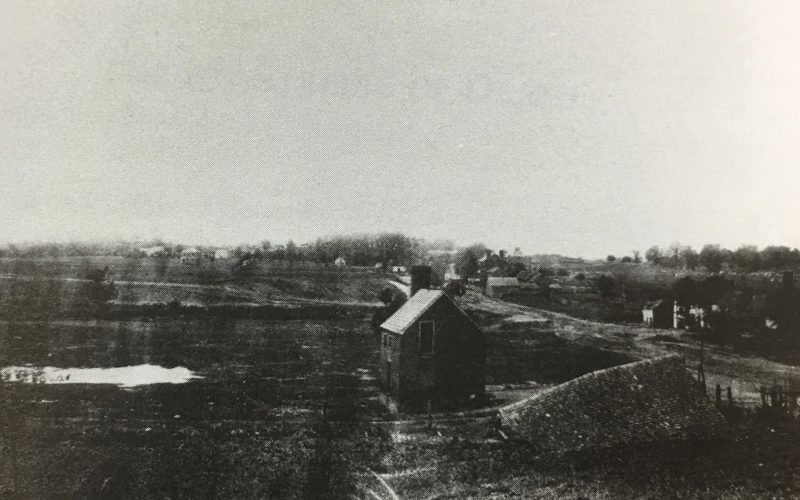
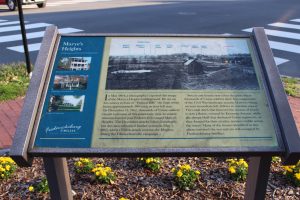
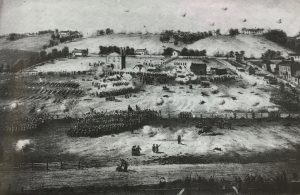
A Northern photographer took this picture of Marye’s Heights in May 1864, setting up his camera in front of “Federal Hill,” a large white house approximately 250 yards to your left-rear. Seventeen months earlier, thousands of Union soldiers caught a glimpse of this panoramic view as they hurried past Federal Hill on their way to attack Marye’s Heights.
Although streets and houses now cover the plain where thousands of soldiers died, important remnants of the Civil War landscape can still be found. Hanover Street, on your immediate left, follows the same course that it did in 1862. The canal ditch that bisected the street has been covered and paved, to make modern Kenmore Avenue, but, the abrupt bluff adjacent to the canal, which sheltered Union soldiers as they formed for their attack, is still visible in the back yard of the house directly across the intersection from you.
Several nineteenth-century buildings still remain.
Research:
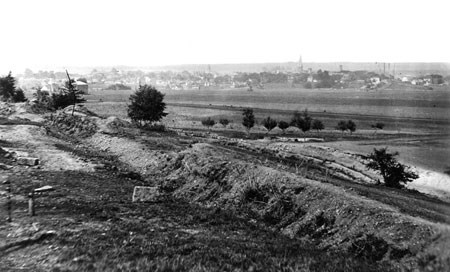
During the American Civil War, Marye’s Heights was the central geographic feature of the Battle of Fredericksburg. The battle was fought on December 13, 1862, and it had a a casualty of 848 Confederate and 7,615 Union soldiers. (2)
In “Fredericksburg and the Assault on Marye’s Heights,” Union soldier Thomas Galwey describes his observations in the days leading up to the battle, the battle itself, and the aftermath of the fighting.
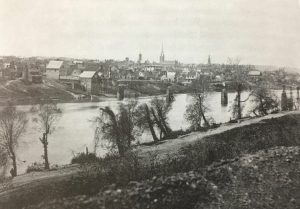
In describing the fighting leading up to the December 13th battle, Galwey states, “The Confederate artillery on Marye’s Heights had thrown an occational shell into the town during the day [December 12th], sending bricks and coping-stones flying about and shattering window-glass by their explosion… the Confederate fire had slackened in the afternoon and had ceased at dark.” (4) And after a day of fighting, Union soldiers ate, drank, and smoked cigarettes, using the town’s offerings to their benefit, after which they fell asleep. Whether it was in a bed inside of a home, in the hallway, outside, anywhere and everywhere one found space, the soldiers went to slept. The next day, they all woke up, had breakfast and were ready for battle by six in the morning. Galwey describes the air the morning of December 13th as being so thick with fog that Marye’s Height was unseeable. (5)
In the time leading up to the battle, Galwey reminisces that soldiers who observed the incline of Marye’s Heights and assessed the military tactics concluded, a “universal opinion [by the soldiers]… that Marye’s Heights could not be carried by direct assault.” (6) Even so, Galwey and the rest of the men were dedicated soldiers that followed the orders of their General.
Galwey reflects that, “Fredericksburg was precisely one of those battles which proved the magnificent character of the Army of the Potomac; for, although knowing the futility of the assault, never, it is confessed by witnesses, Confederates and Federals alike, did soldiers march into the face of defeat and death with greater steadiness and with firmer determination to go as far as men could go than was shown by the Army of the Potomac hour after hour that day, until night and darkness closed in and stopped the slaughter.”(8)
In the battle of Marye’s Heights, Galwey and the rest of the Union soldiers were going up an incline while Confederate soldiers, at the top fired down bellow at them.
Historian Victor Brooks writes of the battle of Fredericksburg as, “the most one-sided Union defeat in a major battle of the Civil War, and the attempt to storm Marye’s Heights was the most one-sided disaster of that battle.” (9)
(1)Goolrick, John T. Old Homes and History Around Fredericksburg (Richmond: Garrett & Massie, 1929), 97.
(2)Brooks, Victor. Marye’s Heights, Fredericksburg. Battleground America Guides. (Conshohocken, PA: Combined Publishing, 2001), 32.
(3)Galwey, Thomas. “Fredericksburg and the Assault on Marye’s Heights.” The Catholic World, A Monthly Magazine of General Literature and Science (1865-1906) 50, no. 297 (1889): 369.
(4)Ibid, 368.
(5)Ibid, 369.
(6)Brooks, 89.
(7) Galwey, 369.
(8)Brooks, 121.