Liberty Town
Inscription:
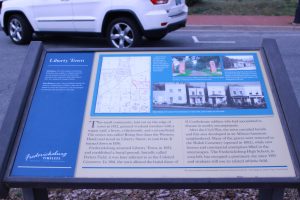
This small community laid out on the edge of town in 1812, greeted overland travelers with a wagon yard, a livery, a blacksmith, and a tavern/hotel. The tavern was called Rising Sun (later the Western Hotel) and stood on Liberty Street, to your front. It burned down in 1836.
Fredericksburg annexed Liberty Town, in 1851, and established a burial ground. Initially called Potters Field, it was later referred to as the Colored Cemetery. In 1861, the town allowed the burial there of 51 Confederate soldiers who had succumbed to the disease in nearby encampments.
After the Civil War, the town curtailed burials and this area developed as an African-American neighborhood. Many of the graves were removed to the Shiloh Cemetery (opened in 1882), while new houses and commercial enterprises filled the streetscapes. The Fredericksburg High School, to your left, has occupied a prominent site since 1919 and students still use its related athletic field.
Research:
Liberty Town was formally incorporated to the city of Fredericksburg in 1851. (1) Prior to its integration, the town was part of different counties and under various patent holders. In 1799 a portion was sold to Seth Barton, and in the years following the property went thorough many planning and plating stages by various platers. In December 29, 1812 Barton “laid out Liberty Town and had John Goolrick draw up a second plat,” which was an “arrangement of thirty-two lots.” (2) Barton developed the property and began selling the lots on January 26, 1813, less than half of the lots were sold before his passing on December 29, 1813. (3)
Most of the lots, with the exception of three, were sold by his estate executors by the end of August 1814. It is thought that “Barton hoped the suburb [of Liberty Town] would complement downtown Fredericksburg as a commercial district,” however, “in 1820, at least half the lots were owned by men who resided elsewhere and thus probably leased the lots.” (5) In the years leading up to the town’s annexation by Fredericksburg, it saw “intermittent prosperity” and many of the lots “remained unimproved.” (6)
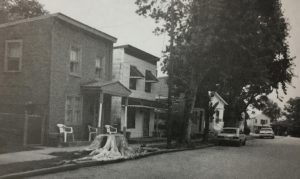
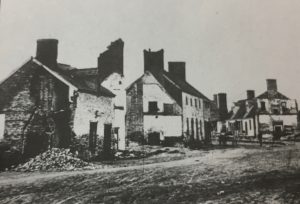
Soon after the annexation of Liberty Town in 1851, the town was badly damaged as a result of the Civil War’s Fredericksburg battles that took place in December of 1862. However, post the Civil War, “there was a great deal of building activity in Liberty Town.”(8) Much of this construction was done by Henry Deane, an African American resident of Fredericksburg. On July 1837 he was born into enslavement, during the Civil War he was a servant to a general, and in 1868 he came to Fredericksburg a free man. (9) Deane married Lucy Combs in 1879 and together they had 11 children, 2 adopted kids, and business endeavors.
Upon coming to Fredericksburg, Deane, worked several jobs and by “cultivating relationships with his white employers,” he bought land that was “unattractive to white developers.” (10) In this acquired land, 19 houses and 2 stables were built, making him a unique success story because no other African American property owner went on to build that many homes. (11)
(1) Gatza, Mary B. Liberty Town : The past and Present of a Fredericksburg Suburb. Virginia Sites and Structures. (Fredericksburg, VA: Center for Historic Preservation, Mary Washington College, 1994), 5.
(2) Gatza, 6.
(3) Gatza, 10.
(4) Gatza, 18.
(5) Gatza, 10.
(6) Gatza, 10.
(7) Gatza, 19.
(8) Gatza, 19.
(9) Scott, Matt. and Stanton, Gary. “Henry Dane: African American Builder and Visionary,” Historic Fredericksburg Foundation Org. Accessed: April 21, 2018.
(10) Scott and Stanton,.
(11) Scott and Stanton,.