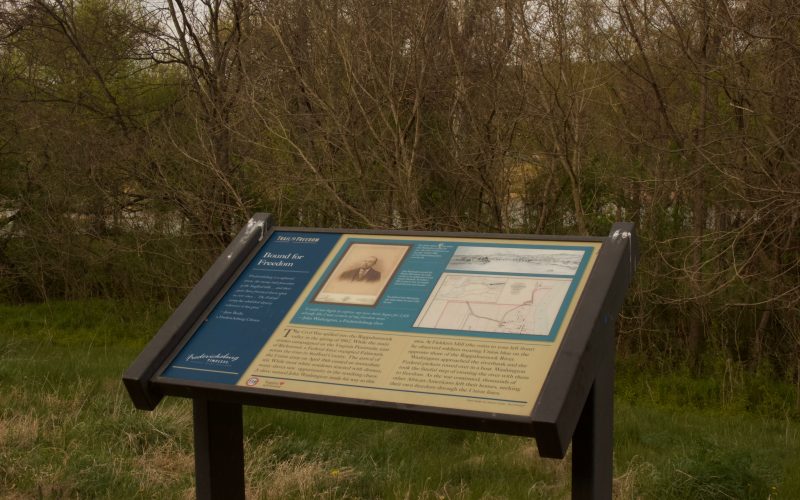
Bound For Freedom
Inscription:
The Civil War spilled into the Rappahannock valley in the spring of 1862. While the main armies campaigned on the Virginia Peninsula, east of Richmond, a Federal force occupied Falmouth, across the river in Stafford County. The arrival of the Union army on April 18th caused an immediate stir.
While most white residents reacted with dismay, many slaves saw opportunity in the resulting chaos. A slave named John Washington made his way to this area. At Ficklen’s Mill (the ruins to your left front) he observed soldiers wearing Union blue on the opposite shore of the Rappahannock River.
Washington approached the riverbank and the Federal pickets rowed over in a boat. Washington took the fateful step of crossing the river with them to freedom. As the war continued, thousands of other African-Americans left their homes, seeking their own freedom through Union lines.
Research:
John Washington, son of Sarah Tucker, was born May 20, 1838, in Fredericksburg, Virginia. Both Washington and his mother were children of white men, so they were both fair skinned. Washington’s complexion provided him some racial ambiguity that he would go on to use to his advantage. As a child, Washington spent some years in Brown farm in Orange County, and at ten he was “moved back to Fredericksburg and lived as a servant to Mrs. Taliaferro.”(1) When Washington was 20 years old, in 1859, his mother and siblings were sold off, and at that moment he “promised himself that if he ever got the opportunity he would run away.”(2) Washington’s mother had run away once when he was three but returned. Additionally, “his grandmother, Molly, was whipped for misbehaving; perhaps she had run away after her sister was sold.”(3) The separation of family members seems to have been a trigger for the enslaved to seek escape.

As a child, Washington’s mother taught him how to spell and later to read. In addition, Washington’s white friends and uncle helped him to read as well. This skill along with “his connections to free blacks, his work ethic, and his urban environment all contributed to his escape.”(5) During the years 1859 and 1862, Washington was hired out to a factory, a tavern, and hotel, wherein he “learned skills and earned cash for himself.”(6) Having had access to money and experiences that were not typical for enslaved people, Washington was more than ready on April 18, 1862, to escape to freedom.

It is said that the owners of the hotel he worked at and the enslaver Mrs. Taliaferro wanted him to join them in their impending journey, and he told them that soon enough he would. While they fled away from the Union army, “John, his cousin James Washington, and another free colored man walked to Ficklen’s Bridgewater Mill, then to the Rappahannock.”(8) The Union soldiers asked them if they wanted to cross over and Washington declared, “Yes, I want to come over.”(9)
Washington answered the many questions of the Union soldiers, most of whom thought he was a white man, and he even gave them a Southern newspaper that he had saved. Washington went on to “serve the Union army as a servant for Major General Rufus King for a period between April and August. He then moved to Washington, D.C.,” and he also went on to write a memoir of his experience as an enslaved person for 24 years.(10) During the December 1862 Fredericksburg Battle of the Civil War, hundreds more enslaved Africans escaped to the Union army in pursuit of freedom.(11)
(1) Steward T. Henderson, “Ex-Slave John Washington,” Emerging Civil War. Accessed: April 24, 2018.
(2) Henderson.
(3) Henderson.
(4) John Hennesy, “John Washington and the Emergence of a Voice for Fredericksburg’s Slaves, Part 1,” Fredericksburg History,(Accessed April 24, 2018).
(5) Henderson.
(7) Hennesy.
(6) Henderson.
(8) Henderson.
(9) Henderson.
(10) Henderson.
(11) “A History of the Fredericksburg Congregation That Became Shiloh Baptist Church (Old Site),” Shiloh Old Site Org. Accessed: April 16, 2018.