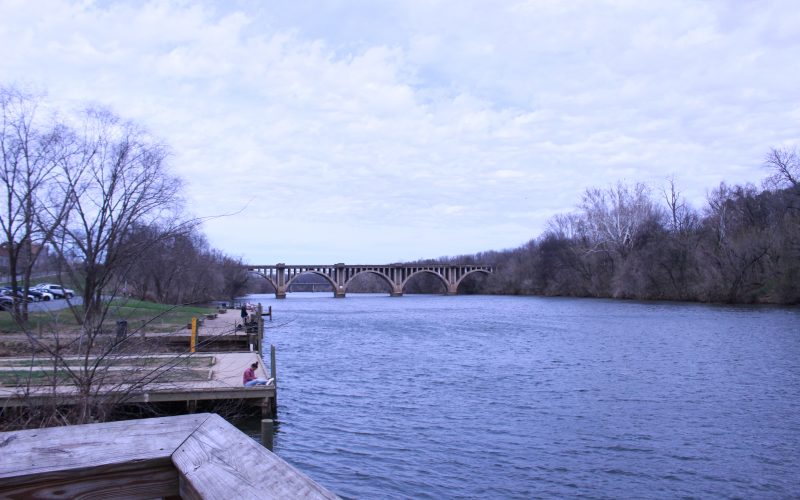
Fredericksburg City Docks – Bridges and Biscuits
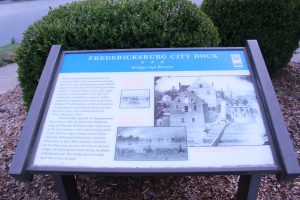
Inscription:
Why was Fredericksburg important to the Union war effort? The answer lies in logistics. The Union army, numbering more than 100,000 troops, required tons of food, clothing and other supplies to operate, Wagon trains could supply the army for short distances, but they were cumbersome and difficult to protect. Longer supply lines required either water or rail transportation. Fredericksburg, with its railroad and close proximity to the Potomac River, provided the Union Army with an ideal base for an “On to Richmond” drive. Three bridges spanned the Rappahannock River here in 1861: the Richmond, Fredericksburg, and Potomac Railroad bridge (which stood at the same location as the modern bridge ahead of you) and two wagon bridges located farther upstream. Retreating Confederates destroyed these spans in April 1862, making it necessary for the Union army to cross the river on pontoon bridges the following December during the Battle of Fredericksburg. The middle pontoon bridge stood here at the city dock.
Research:
![Fry, Joshua, Approximately, Peter Jefferson, and Thomas Jefferys. A map of the most inhabited part of Virginia containing the whole province of Maryland with part of Pensilvania, New Jersey and North Carolina. [London, Thos. Jefferys, 1755] Map. Retrieved from the Library of Congress, https://www.loc.gov/item/74693166/. (Accessed March 30, 2018.)](http://www.virginiaplaces.org/transportation/graphics/cartouche2.gif "https://lccn.loc.gov/74693166")
Decades after the hard-fought and successful battle against Great Britain, the Fredericksburg City ports and docks underwent changes within their trade system. The new ships that were constructed were far too big to navigate the Rappahannock River changing the routes of oceanic trade ships to land elsewhere. This change took away Fredericksburg’s access to worldwide trade (4).
While the port was not involved in world trade anymore, Fredericksburg in 1838 still used the port for steamer travel to go to Baltimore. This city dock for steamer ships remained active well into the twentieth century (5).

Interest in Fredericksburg during the Civil War nicknamed the city, “Gateway to Richmond”, making Fredericksburg one of the most fought over lands in the Civil War (6). The Battle of Fredericksburg was comprised of battles that utilized the Rappahannock River. On November 19, 1862, the Union Army, under the direction of General Burnside, planned to cross the river on pontoons. After waiting two weeks, the pontoons arrived, but Burnside still waited for the right moment to strike Fredericksburg (7). However, because of the long wait, General Robert E. Lee and Stonewall Jackson’s men were meanwhile readying themselves for battle across the river in Fredericksburg.
The Union Army used cannon fire on Fredericksburg knocking down buildings and killing civilians and Confederate soldiers. Finally, they engaged in their opportunity and assaulted the city (8). Burnside aimed to concentrate his attack on Marye’s Heights near Sunken Road. Little did Burnside know that there were Confederate soldiers patiently waiting for the Union troops (9). Their location decimated the Union army ending the Battle of Fredericksburg as a Confederate victory. The battle still came at a cost resulting in 17,929 casualties of the 172,500 forces involved (10).
The docks and Rappahannock River in Fredericksburg had not only helped the city come to be as an economically viable trading post but it also later facilitated one of the most dilapidating battles Fredericksburg experienced during the Civil War.
Featured Image:
Lakelyn Wiley, “The Rappahanock River in Frederickburg, Virginia,” 2018.
(1) Suzanne Steiner Hintz, and Laura Daughtry, “A Brief History of Fredericksburg,” The Fredericksburg Connection: Selected Readings Tracing the History of Fredericksburg, and Stafford and Spotsylvania Counties, (Fredericksburg, Va: Historic Fredericksburg Foundation, 1980), 21.
(2) Ruth Fitzgerald, “African American History of Fredericksburg,” Central Rappahannock Regional Library, http://www.librarypoint.org/african_american_history_of_fredericksburg_virginia, (accessed March 31, 2018).
(3) Hintz, “A Brief History of Fredericksburg”, 21.
(4)Hintz, “A Brief History of Fredericksburg”, 24.
(5) Ibid.
(6) Hintz, 130.
(7) Hintz, “The Story of Fredericksburg 1861-1864″, 131.
(8)”Fredericksburg,” Civil War Trust, https://www.civilwar.org/learn/civil-war/battles/fredericksburg, (accessed March 31, 2018).
(9) Ibid.
(10)Ibid.
(11) “shipping tobacco hogsheads (wooden barrels loaded with 1,000 or so pounds of dried tobacco leaves),” Digital Image, Library of Congress, http://www.virginiaplaces.org/transportation/colonialshipping.html.
(12)”Battle of Fredericksburg: The Army of the Potomac crossing the Rappahannock: in the morning of December 13, 1862, under the command of Generals Burnside, Sumner, Hooker & Franklin,” Digital Image, Library of Congress, 1888.
(13) Lakelyn Wiley, “The Rappahannock River Viewed from the Docks,” Digital Image, 2018.