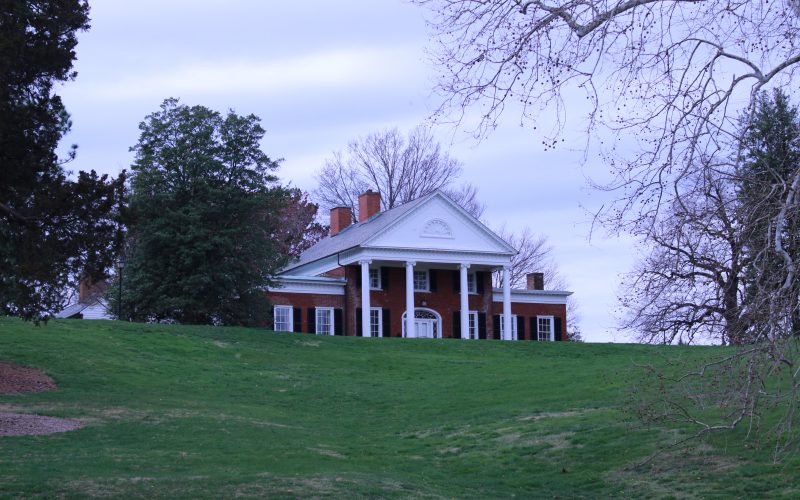
Brompton – The Battle of Fredericksburg
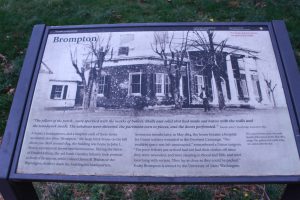
Inscription:
“The house and grounds are not open to the public.
“The pillars of the porch…were speckled with the marks of bullets. Shells and shot had made sad havoc with the walls and the woodwork inside. The windows were shivered, the partitions torn to pieces, and the doors perforated.”
Traveler John T. Trowbridge, September 1865
A home, a headquarters, and a hospital: each of these terms accurately describes “Brompton,” the large brick house one the hill above you. Built around 1824, the building was home to John L. Marye, a prominent lawyer and businessman. During the Battle of Fredericksburg, the 3rd South Carolina Infantry took position in front of Brompton, while Colonel James B. Walton of the Washington Artillery made the building his headquarters.
Seventeen months later, in May 1864, the house became a hospital for Union soldiers wounded in the Overland Campaign. “No available space was left unoccupied,” remembered a Union surgeon. “the poor fellows just arrived had not had their clothes off since they were wounded and were sleeping in blood and filth, and were swarming with vermin. They lay as close as they could be packed.” Today Brompton is owned by the University of Mary Washington.”
Research:
For most residents in Fredericksburg, Virginia, Brompton, originally known as Marye House, is the home of the President of the University of Mary Washington. The house was built in 1838 by John Lawrence Marye, for which the hill it sits atop of is called.(1) The house itself saw a lot of the warfare during the Battle of Fredericksburg, especially during its use as a Confederate stronghold against the Union Army. (2)
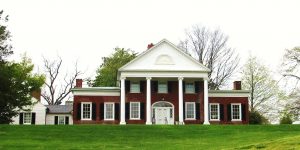
The land on which Brompton sits was originally owned by Fielding Lewis, a brother-in-law to George Washington.(4) The name Brompton was given to this house after a member of the Marye family, who later owned the property, took refuge in and later relocated there.(3) A lawyer John Lawrence Marye began building Brompton shortly after 1821, adding the wings on to it to give the home a “graceful appearance that it still enjoys today.”(5) The Marye family did not spend long in this house. Mr. Marye’s political leniencies – he was a member of Virginia’s secession convention – is what later led him and his family to flee to Forest Hill when Union forces marched on Fredericksburg. (6)
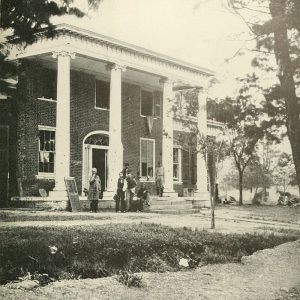
After Marye’s flight, Col. James Walton commandeered this building as his headquarters. On December 13, 1862, as the Battle of Fredericksburg began, Confederate fire from Marye’s Heights caused an extreme amount of casualties. The height advantage the Confederate army held was further solidified by the usage of “sharpshooters firing from the upper windows of the Marye House.” (7) The casualties of this battle have been talked about grossly, but one casualty of this battle is the façade of Brompton.
A soldier staring on Brompton after the battle remarked,
Not an inch of the surface of the bricks on the front of the house was free from the mark of a Minié ball. Bushels of flattened ones were to be seen on the ground, while the woodwork was torn to pieces by them.(8)
In the picture of, you can see clearly see where the Minié balls had removed chunks in the columns, as well as the broken windows, and chunks of missing brick. Another soldier remarked on the severely damaged state of Brompton by saying the building had been “raked by musket balls until it looks as if a hail storm had scoured it.”(9) However damaged it was after this first wave in December, the second Battle of Fredericksburg five months later further harmed Brompton. A man who looked at the house in 1864 commented,
Ah! It was a sad thing to thread the deserted halls and chambers of this old house and hear only the echo of your footsteps… Not even a rat squeaks behind the wainscot. The silence is awful.(10)
In the year since the home was abandoned by John Marye and his family, the former glory of the home had been completely stripped away by bullets and soldiers alike. Even the gardens of Brompton were completely destroyed and uprooted by the earthworks and graves that extended beyond the grounds. But the story is not over yet.
Once again Brompton was caught in the middle of the Civil War, during the Battles at Wilderness and Spotsylvania Court House Fredericksburg as a whole became a huge hospital. The Ninth Corps surgeons commandeered the now empty Brompton, packing the house with hundreds of injured men. Surgeon William Howell Reed described the scene inside Brompton,
The poor fellows had not had their clothes off since they were wounded, and were sleeping in blood and filth, and were swarming with vermin. They lay as close as they could be packed, the contaminated air growing worse every hour. The openings in the torn and battered walls assisted somewhat in ventilation.(11)
By 1864, the state of Brompton was left to only bloodstained floors and bullet-riddled walls. It’s phases of usage as a headquarters, stronghold, hospital, and cemetery transformed this beautiful plantation style home into a skeleton of pre-War grandeur. The Marye family returned to the home in 1865 to begin repairs until his death in 1868. The home passed through the hands of a Mr. John G. Lane, who sold it to Captain Maurice B. Rowe, who transformed the estate into a successful dairy farm.
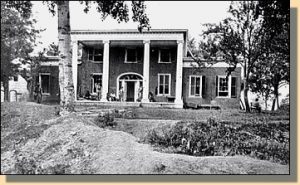
The history of Brompton is similar to the history of most other historic buildings in Fredericksburg, Virginia. The impression that the house left on the soldiers who fought at the Battle of Fredericksburg was a great one, as one veteran asked to be married there. He explained to the owner at the time that “he was unable to take Marye’s Heights by storm in December of ’62, [and[ that he wanted to take it now in his own way by being married there.”(12) The bullet holes left in the brickwork only tell a story of American loss and war. However, its status as a historic building makes it a sight to see for anyone visiting Fredericksburg.
Featured Image:
Lakelyn Wiley, “Brompton in Fredericksburg, Virginia,” 2018.
(1) Douglas S. Freeman, Susanne Christian, Frances Archer & Massie Williams, ed., Homes And Gardens in Old Virginia (Whitefish, MT: Kessinger Publishing, 2006), 39.
(2) Victor Brooks, Marye’s Heights, Fredericksburg: Battleground America (Boston, MA: Da Capo Press, 2001), 35.
(3) Edward Alvey Jr., History of Mary Washington College 1908-1972 (Charlottesville, VA: University Press of Virginia, 1974), 294-5.
(4) “Fielding Lewis,” The George Washington Foundation: Fielding Lewis, 2014, accessed March 21, 2018. http://kenmore.org/genealogy/lewis/fielding_lewis.html
(5) Donald C. Pfanz, “Brompton: Front Door on the Battle,” Fredericksburg.com, accessed 22 March 2018. http://civilwar.fredericksburg.com/Battle/0721CW
(6) “John Lawrence Marye, Sr.,” Find A Grave, accessed 22 March 2018. https://www.findagrave.com/memorial/8866158
(7) Pfanz, Ibid.
(8) Ibid.
(9) Ibid.
(10) Ibid.
(11) William Howell Reed, Hospital Life in the Army of the Potomac (Boston, MA: W. V. Spencer Publishers, 1866), 47.
(12) Pfanz, Ibid.
(13) Sofie Wachtmeister, “Brompton (Marye House) Fredericksburg,” The Clio, published 27 April, 2014, accessed 22 March 2018. Picture added by Sofie Wachtmeister. https://www.theclio.com/web/entry?id=3548
(14) Wachtmesiter, 2014. Picture added by Mike Emett on 25 August 2016.
(15) Wachtmeister, 2014. Picture added by Mike Emett on 25 August 2016.