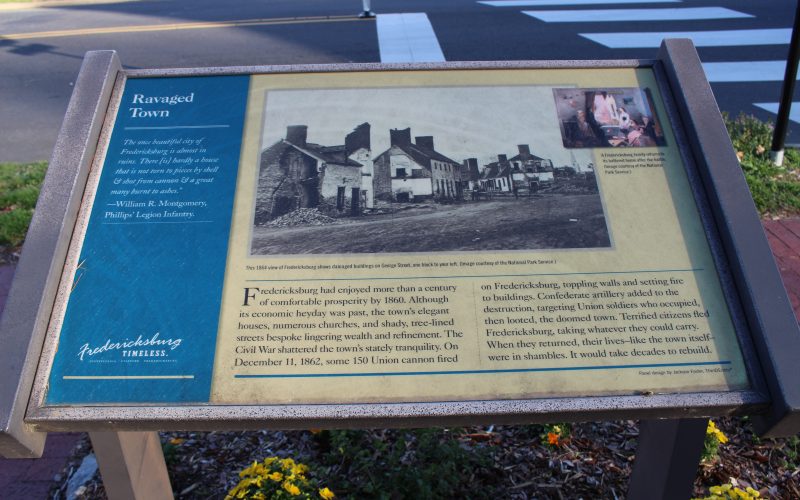
Ravaged Town
Inscription:
Fredericksburg had enjoyed more than a century of comfortable prosperity by 1860. Although its economic heydey was past, the town’s elegant houses, numerous churches, and shady, tree-lined streets bespoke lingering wealth and refinement.
The Civil War shattered the town’s stately tranquility. On December 11, 1862, some 150 Union cannon fired on Fredericksburg, toppling walls and setting fire to buildings. Confederate artillery added to the destruction, targeting Union soldiers who occupied, then looted, the doomed town.
Terrified citizens fled Fredericksburg, taking whatever they could carry. When they returned, their lives—like the town itself—were in shambles. It would take decades to recover.
Research:
Photo Credits: Before James Gardner/LOC After Google Street View. Destruction caused by Union army on Caroline Street, Juxtapose by John Banks (1)
The Civil War battle in Fredericksburg began on December 11, 1862 when Union soldiers, building pontoon bridges to get into the city, began firing at Confederate shooters, who were attempting to stop the building of the bridge.(2) The battle of Fredericksburg took place at two points, bellow Fredericksburg and at Marye’s Height. Fighting continued until December 15, when the Union army withdrew. (3)
The destruction of homes and infrastructure began immediately in Fredericksburg. The Fredericksburg City Government website details the assault on the city stating, “The Union Army charged into town and ransacked homes and businesses searching for Confederate soldiers.”(4) Residence had fled the city, leaving homes, businesses and public spaces, all of which were susceptible to the barbarity and destruction of war. The Civil War Trust states that, “…Burnside ordered Union artillery to bombard the town. The ensuing barrage damaged nearly every house. The shelling of Fredericksburg was arguably the first time a commander deliberately ordered a large-scale bombardment of a city during the Civil War.”(5)
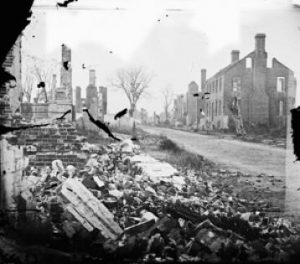
The war made complicated a town that had long been a historic city that maintained its simplicity and quite livelihood. While the city had 5,000 residents, on third of whom were enslaved, “by the time of battle, likely fewer than 1,000 residents remained in town. Most had taken to the countryside, destined for impromptu refugee centers and friends’ farms in Spotsylvania County.” (7) For those that stayed, there was a lot of horror and destruction left to be seen. Fanny White, ten years old at the time of battle, describes the suspense of being a civilian during a state of war, “For long hours the only sounds that greeted our ears were the whizzing and moaning of the shells and the crash of falling bricks and timber.” (8) While some residents hid for shelter, the war continued outside, and soon the Union soldiers would come into the city and take for themselves, food, tabacco, and space for rest.
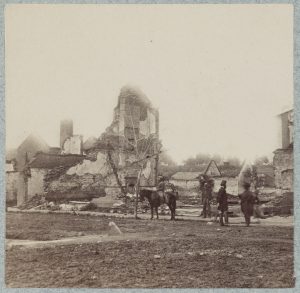
The destruction of the town by artillery and looting, has been described by soldiers and sympathizers of both the Union and Confederate army. One Union soldier described the event stating, “Fredericksburg is given up to pillage and destruction. Boys came in loaded with silver pitchers, silver spoons, silver lamps, castors, etc… Closets of the very finest china were broken into and their contents smashed onto the floor and stamped to pieces… the soldiers seemed to delight in destroying everything.”(10) In a contrasting observation, Union soldier Thomas Galwey reasons, while “the right to plunder the conquered was of old [and] least cruel,” Galwey argues “the men of thievish propensities who rifled the houses of that city were but few in proportion” and “when the retreat from the city finally took place the provost-guard seized most of the booty from the plunderes and left it piled up to be reclaimed by the citizens on their return.” (11) While there are some argument on the extent of the looting, the evidence of destruction was left bare for the citizens of the city to witness.
Fanny White, the young child mentioned earlier, describes her home after the battle stating, “Our pretty garden was strewn with cannon balls and pieces of broken shells, limbs knocked off the trees, and the grape arbor a perfect wreck.” (12) By the end of the Civil War the City of Fredericksburg had been radically changed, “more than 80 buildings [were] destroyed – just under 10% of the city” and “personal wealth dropped by more than 70%.”(13) The Civil War is a central feature of the city’s history, the buildings that exist today, both new and old are on memorable grounds.
(1) Banks, John. “Destruction Caused by Union Army on Caroline Street,” Citywarthenandnow.blogspost. May 12, 2016.
(2) Willis, Barbara P. and Felder, Paula S. Handbook of Historic Fredericksburg Virginia (Fredericksburg: Historic Fredericksburg Foundation, 1933), 51-52.
(3) Willis, 52.
(4) “Civil War (1861-1865),” Fredericksburg Virginia gov. Accessed: April 15, 2018.
(5) “10 Facts: Fredericksburg,” Civil War gov. Accessed: April 15, 2018.
(6) Hennessy, John. “Voices from the Storm: Civilians Endure the Battle of Fredericksburg,” Civil War gov. Accessed: April 15, 2018.
(7) Hennessy, “Voices from the Storm.”
(8) Hennessy, “Voices from the Storm.”
(9) “Views in Fredericksburg, Va., showing destruction of houses by bombardment on December 13,1862,” Library of Congress. Accessed: April 15, 2018.
(10) Hennessy, “Voices from the Storm.”
(11) Galwey, Thomas. “Fredericksburg and the Assault on Marye’s Heights.” The Catholic World, A Monthly Magazine of General Literature and Science (1865-1906) 50, no. 297 (1889): 367.
(12) Hennessy, “Voices from the Storm.”
(13) Hennessy, “Voices from the Storm.”