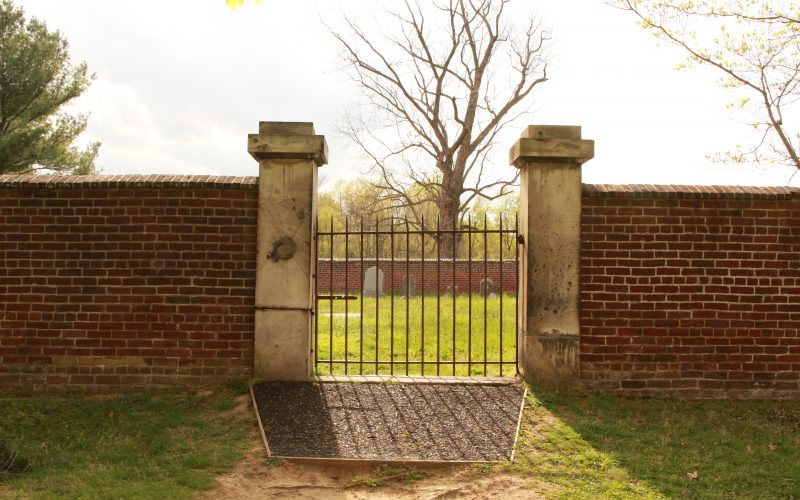
Willis Hill Cemetery
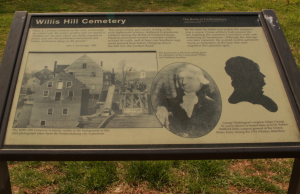
Inscription:
This quiet hilltop graveyard, dating to the mid-eighteenth century, sheltered Confederate soldiers during the Battle of Fredericksburg. Medical personnel treated wounded soldiers behind its walls, and at least one Southern regiment paused here before charging down the hill into the Sunken Road.
By the time the battle had ended, the cemetery was a wreck. Union artillery had scoured the hill, toppling the cemetery’s red brick walls and shattering its headstones. Although the damage was later repaired, the scarred marble gateposts stand as reminders of the fury that once engulfed this peaceful spot.
Research:
The Willis Hills property, which the cemetery is in, was named after the first settler of the location, Colonel Henry Willis. Willis was “a member of the House of Burgesses, [and he] helped establish the city of Fredericksburg when the Colonial Act of 1728 appointed him a trustee of the city.”(1) The Hills property continued to passed to down the Hills family line, until it burned down in 1825, under the ownership of Byrd C. Willis. Byrd then sold the property and moved to Florida. The property was sold again in 1856 and later in 1860. As the property continued to change ownership, the number of homes on the property continues to grow. In addition to homes, what is now the Willis Hills Cemetery was being developed. The cemetery is said to have “thirty-five stones with the earliest dating from 1756.”(2)
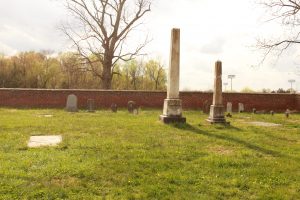
During the Civil War’s Fredericksburg Battle of December 1862, Willis Hills and Marye’s Heights were one of the central locations that the battle took place. “Captain Charles W. Squires [Confederate]… posted two 3-inch rifled cannons in gun pits in front of the Willis Cemetery and besides one of the several brick structures on the crest.”(3) In addition, the brick wall was used as a shield of ammunition and horses, while one of the homes became a makeshift hospital. On December 13, 1862, the second and last day of this round of fighting in Fredericksburg, the Confederate army continued to use the cemetery’s brick structure as protection.
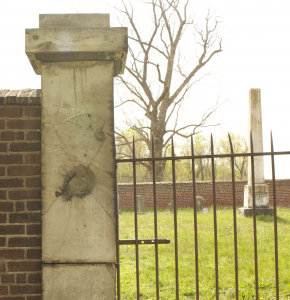
During of the Spring of 1863, Willis and Marye’s Hills once again were at the crosshairs of battle. Again Captain Squires was using the Willis Hills for defense. Unlike the December battle, however, the Union army was gaining ground. The attacks on the Hills property were great, “their concentrated fire destroyed the brick dwelling on Willis Hill, collapsed portions of the cemetery wall, and knocked over many of the tombstones.”(4) The Union soldiers finally broke through the defense at the bottom of the hills and ran up to the Willis Hills property. After a serious of gunfights, turned fist-fights, the Confederate army was under siege.
The Confederates lost that second battle of Fredericksburg, but it was not the last time the Hills saw soldiers. In 1864, “Northern soldiers wounded in the fierce battle of the Wilderness and Spotsylvania flocked over the grounds looking for aid,” and the Hill and its buildings temporarily became hospitals.(5) To this day, one can still find some evidence of the destruction that once took place here.
(1) “Willis Hill During the Civil War,” National Parks Service. Accessed: April 24, 2018.
(2) “Willis Hill During the Civil War.”
(3) “Willis Hill During the Civil War.”
(4) “Willis Hill During the Civil War.”
(5) “Willis Hill During the Civil War.”