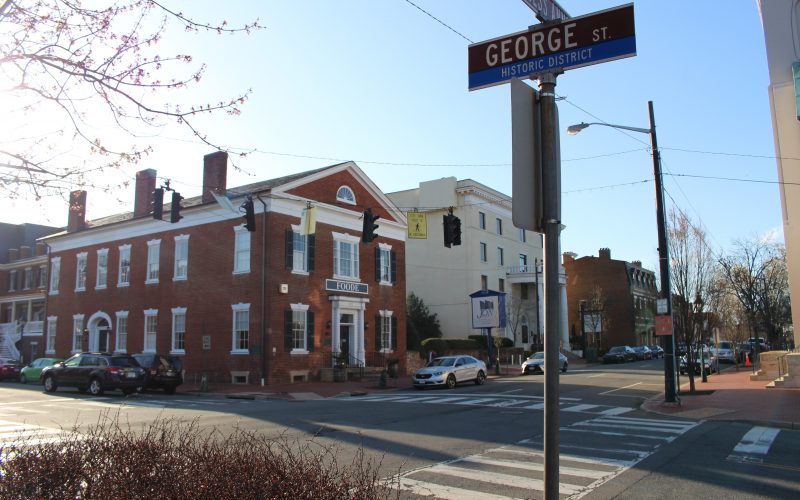
“Hostages”
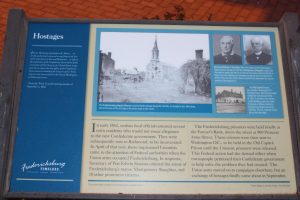
Inscription:
In the summer of 1862, Confederate authorities imprisoned four Union men from Fredericksburg and Spotsylvania County. The arrested Unionists were local citizens in good standing, but who refused to renounce their allegiance to the United States. They were imprisoned in Richmond for disloyalty to the Confederacy.
In July and August, Federal authorities retaliated by rounding up nineteen local men, holding them briefly at the Farmers Bank (now the National Bank of Fredericksburg**, two blocks to your right), and then sending them to the OldCapitol Prison in Washington, D.C. The Federal response was heavy-handed, but the arrest of prominent citizens, including Mayor Montgomery Slaughter and Reverend William Broaddus, had the desired effect and an exchange of hostages came about within two months.
The Old Capitol Prison was initially a Washington D.C. boarding house. Located at the corner of First and A Streets, NE, it had served as the nation’s capitol building (hence the name) after British troops sacked the city during the War of 1812. John Quincy Adams was sworn in as the nation’s president there and John C. Calhoun had lived and died there. It became a holding facility for temporary prisoners during the Civil War. The U.S. Supreme Court sits on the site today.

**Note: Although the marker states that it is now the National Bank of Fredericksburg, it is not. Since 2016, the bank has been renovated and is now “Foode”, an upscale farm to table restaurant.
Research:
In the year 1811, the Bank of the United States collapsed. This fostered the need for a bank for Virginia. The General Assembly passed legislation that established the Farmers Bank of Virginia on February 13, 1812. The Assembly specified that there would be a mother Bank in Richmond supported by other branches around Virginia in Fredericksburg, Winchester, Lynchburg, Petersburg, and Staunton (1).

The Farmer’s Bank building at 900 Princess Anne Street was built by Robert and George Ellis for $10,000, beginning in 1819 and finishing in 1820. The building is late eighteenth-century federal-style and constructed with smooth-textured and tight composite red brick (2). “It features a slate-covered front gable roof with a lunette window in the front pediment, wide cornice, three pairs of brick chimneys, and engaged pedestal columns with full entablature on the front facade”(3).
The front of the building was used as the banking house since its erection while the rooms in the back of the building and on the second floor, served as the home of the cashiers and families from 1820-1920 (except for times during the Civil War when the town was occupied by Union troops). The residential section of the bank was designed to house the bank’s cashier. The Farmers Bank dwelling space was the childhood home of Captain William Lewis Herdon, a 19th-century Naval hero who was the commander of a sinking ship. Herdon succeeded in saving 150 of his men and paid the ultimate sacrifice (4).

The bank, like Fredericksburg, was doing very well up until the outbreak of the Civil War. Fredericksburg was in a literal war zone and it was hard to operate as a well-functioning bank. Further, the employees working for the bank soon decided to go off to war leaving the bank practically empty (5). The cashier at the time, William Ware, took all of the special information and bank notes to Danville, Virginia to protect it from the violent nature of the Civil War (6).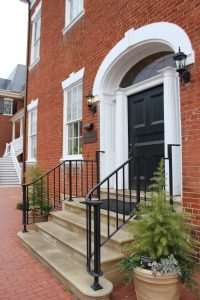
In April 1862, Fredericksburg was under occupation by Union Forces led by General Marsena R. Patrick who then took over the Farmers Bank for his military headquarters(7). During this occupation, on May 23, 1862, President Abraham Lincoln traveled down to Fredericksburg to speak to the town (8).

The Union forces, while in control of the city, rounded up nineteen of the most esteemed individuals in town and arrested and imprisoned them because they had previously arrested four union sympathizers in Fredericksburg. A memoir by slave John Washington recounts the arrests of prominent members of the Confederate community and details that Washington himself had been one of the people that pointed them out to the Union. After they were held hostage in the Bank, they were sent to the Old Capitol Prison in captivity for upwards of six weeks After the Confederacy regained control of Fredericksburg, John Washington fled and never returned to Fredericksburg again (9).
Following the hostilities, the war-torn Farmers bank struggled to its feet and ultimately became The National 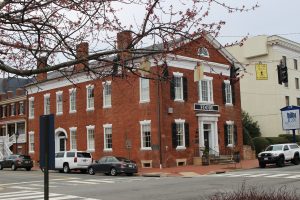 Bank of Fredericksburg on October 11, 1865 (10). The bank purchased the entire building, furniture and all, for $10,000 and continued to operate a banking house in the structure into the early twenty-first century (11).
The 1950s witnessed the first drive-thru teller window that actually incited a major controversy over the preservation of the building (12).
Following the 1950 drive-thru controversy, the Historic Fredericskburg Foundation Inc. was formed in order to help preserve other sites that need additional preservation work (13).
In 1982, the first bank underwent extensive preservation to help preserve the authenticity of the federal style building. The Farmers Bank later became the PNC bank and continued to operate until November 21, 2014; 194 years of banking finished (14). In 2016, the bank went through another phase of a preservation restoration to become the restaurant “Foode”.
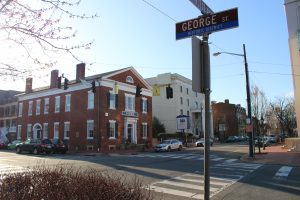
Featured Image:
Lakelyn Wiley, “The Original Fredericksburg National Bank in Fredericksburg, Virginia,” 2018.
(1) S.J. Quinn, The History of the City of Fredericksburg Virginia. “Gen. Pope Takes Possession of the Town,” eBook, (Richmond, VA: Hermitage Press Inc.), 1908. http://www.gutenberg.org/files/41597/41597-h/41597-h.htm#CHAPTER_VI., 77.
(2) Lemuel W. Houston,”Farmers Bank of Fredericksburg,” National Register of Historic Places, (United States Department of the Interior), January 18, 1983. https://www.dhr.virginia.gov/registers/Cities/Fredericksburg/111-0021_FarmersBankofFredericksburg_1983_Final_Nomination.pdf, 2.
(3) Houston, 3.
(4) John Hennessey, “Is this the most important era building in the Fredericksburg region?,” Mysteries and Conundrums, WordPress, August 1, 2014. https://npsfrsp.wordpress.com/2014/08/01/is-this-the-most-important-civil-war-era-building-in-the-fredericksburg-region/.
(5) Houston, 5.
(6) Ibid.
(7)Ibid.
(8) Hennessey, “Is this the most important era building in the Fredericksburg Region?”.
(9) Ibid.
(10) Richard Amrhine, “Bank Building is Vault of History,” Free Lance-Star, (June 28, 2016). http://www.fredericksburg.com/townnews/bank/bank-building-is-vault-of-history/article_699b710d-dd5f-56c3-9e6f-955b1f9f2e58.html
(11) Ibid.
(12) Ibid.
(13) Elizabeth Anthony, Kathy Gould, Martha Harding, Claire Kelly, and Victoria Via, The National Bank of Fredericksburg, Preservation Reports: Virginia Sites and Structures. edited by Belle Pendleton. (Fredericksburg, Virginia: Center for Historic Preservation), 1982.
(14) Amrhine, “Bank Building Is Vault of History”.