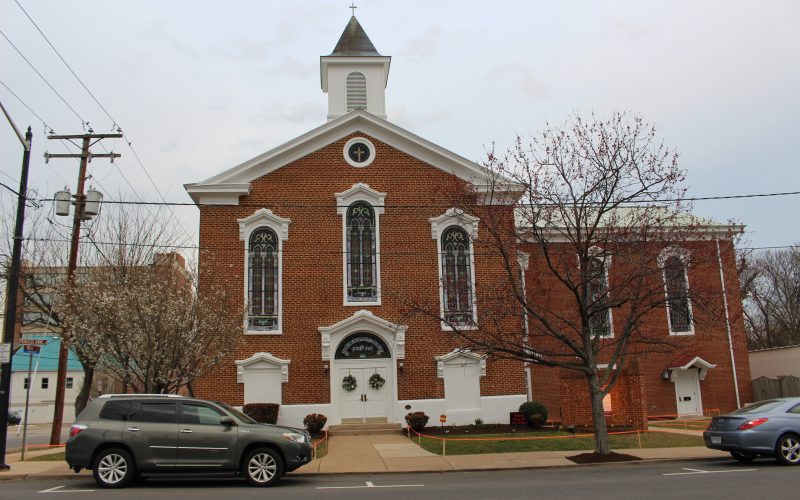
Shiloh Baptist Church (New Site)
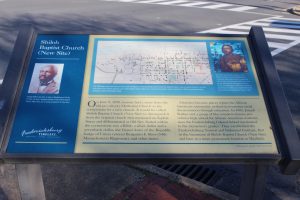
Inscription:
In 1886, the African Baptist Church, on Sophia Street, sustained serious flood damage. The congregation purchased a new site on higher ground, but a clouded deed delayed construction. In the interim, approximately half of the members decided to rebuild their church on the old site. The other half erected the sanctuary in front of you, in 1890, and named it the Shiloh Baptist Church (New Site).
At that time African-Americans sought to overcome racial discrimination through education. In 1906, Joseph Walker and a group of like-minded citizens decided to provide a high school for black students, since Fredericksburg Colored School was limited to the elementary grades. They established the Fredericksburg Normal and Industrial Institute, which opened in the basement of the Shiloh Baptist Church (New Site), but eventually moved to a more permanent location in what would later become the black community of Mayfield.
Research:
Shiloh Baptist Church (New Site) was established in 1890 when a rift occurred in the Shiloh Baptist Church, resulting in the congregation splitting into “Old Site” and “New Site” churches. The first Baptist meeting house in Fredericksburg was said to be established in 1804, “near what is now the Fredericksburg train station on Lafayette Boulevard.”(1) The congregation was comprised of “white folks, enslaved and exploited black folks, and a few individuals known as ‘free Negroes.”(2) In the years to come the original congregation underwent relocation, splitting, and building renovation. In 1815 the congregation relocated to the current location of the Old Site church, and in that same location in the 1830-1840s “a brick church building was erected,” and was known as the “Shiloh Baptist Meeting House.”(3) In 1849, there was an interest in building an exclusively white Baptist church. When a committee was established to seek financial backing for the new church, they “recommended that the existing building… be ‘given’ to the black members… provided that the ‘colonials’ – the term used in the church minutes for slave owners- made a pledge of $1,100 or more.”(4)
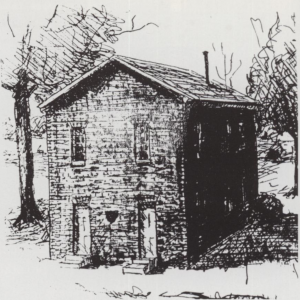
As the white congregation left, they required a payment of $500 to sell to the church they were leaving behind to the black congregation.(5) Afterward, the black congregation continued to practice– and as required by law– they did so under the supervision of a white pastor. Church practices continued until the onslaught of the Civil War made service impossible because the building “was being used by the Union forces as a hospital and it also suffered severe structural damage.”(6) After the war and the abolition of slavery, the church began to function on its own, without white supervision. In 1865 repair of the church began. In 1882, the reverend and several deacons “purchased several acres of land that became the site of the Shiloh Colored Cemetery of Fredericksburg.”(7) In the early 1880s, Reverend Willis Robinson raised $1,500 for “repairing the building, but the deacons were not willing to start the work until all the money was on hand,” unfortunately, “In June 1886, the rear wall fell rendering Shiloh useless and unsafe.”(8)
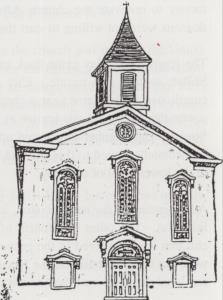
In the year following this incident, the church began meeting at the courthouse for service and actively sought new property to build on. A new location, Revere Shop, was soon selected and agreed upon, however it soon became apparent that “only three-fourths of the [Revere Shop] property was free of litigation.”(10) With this set back the congregation was not ready to rebuild on the Revere Shop, however, the old site had become free for rebuilding, so a vote was held to decide whether to build on it. In May 1887 vote, the vote took place and “members voted to build on the Revere site,” but on June 1, 1887, another body of the church met and “voted to build on the old site.”(11) On November 30, 1888, a court case deemed the June 1887 meeting unlawful and the actions non-binding. Another issue arose when both churches wanted to use the same name, Shiloh Baptist Church. In the end, the courts came to the decision that each church could keep the name with the edition of “Old Site” and “New Site” to their titles.
On June 9, 1890 construction of Shiloh Baptist Church (New Site) began and in the years following the church grew in size and its outreach to the community. In regards to education, “the first Black high school in the area, The Fredericksburg Normal and Industrial Institute, had its beginnings in the basement of [New Site] church.”(13) During the Civil Rights movement, the church, “the largest black church in the area,” was a strategic meeting place because it was conveniently located in-between Washington D.C. and Richmond. In the decades following, the church continued to renovate and expanded its building and grow in size.
(1) “A History of the Fredericksburg Congregation That Became Shiloh Baptist Church (Old Site),” Shiloh Old Site Org. Accessed: April 16, 2018.
(2) ”A History of the Fred.”
(3) ”A History of the Fred.”
(4) ”A History of the Fred.”
(5) “Church History,” Shiloh Baptist Church (New Site), (2014).
(6) “Church History”
(7) “Church History”
(8) “Church History”
(9) Celebrating Our Heritage : Holy, hallowed and historical 1888-1998 ; Shiloh Baptist Church (New Site). (Galion, Ohio: United Church Directories, 1998) 8.
(10) “Church History”
(11) “Church History”
(12) Celebrating Our Heritage.
(13) “Church History”