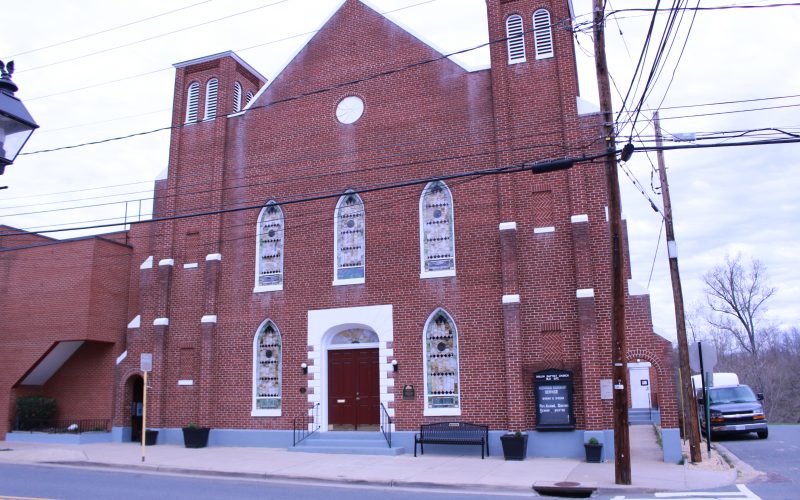
Shiloh Baptist Church (Old Site)
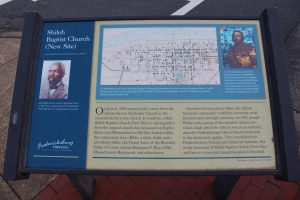
Inscription:
Former slaves, as well as free blacks, realized that education was critical to African-American aspirations. Immediately after the Civil War, the Shiloh Baptist Church organized a school for black students. The Freedmen’s Bureau supported this effort, with funding, and Northern white teachers came to provide instruction. One such missionary, a woman from Ohio named Sophia Hatch taught students here and at other black schools in Fredericksburg until 1890.
In addition to promoting education, black churchmen became politically active. In 1876, the Reverend George Dixon and a group of residents proposed a slate of black candidates for local office. None were voted in, though, and the end of Reconstruction effectively curtailed further attempts to obtain black representation. Not until 1966 was a black person elected to Fredericksburg City Council. The candidate was Reverend Lawrence A. Davies, who subsequently ran for mayor in 1976 and served in that capacity until 1996.
Research:
Shiloh Baptist Church (Old Site) was established in 1890, but “its congregation dates back to early nineteenth century.”(1) Old Site’s history started in 1804 when the first Baptist meeting house was said to be established in Fredericksburg. (2) In 1815 there was a relocation of the congregation, they moved their meeting location to what is now Old Site’s location. By the 1830s-1840s, a brick church was built at what is now the Old Site, but it was then called, “the Shiloh Baptist Meeting House.”(3) Again in 1849, there was interest in building a new Baptist church, this one was exclusively for whites. The committee that was responsible for getting funding for the new church “recommended that the existing building… be ‘given’ to the black members… provided that the ‘colonials’- the term used in the church minutes for slave owners- made a pledge of $1,100 or more.” (4) From the inception of the Baptist church, the congregation had been a mixed crowd of “white folks, enslaved and exploited black folks, and few individuals are known locally as ‘free Negroes’,” and at one point in the 1830s-1840s it is estimated that “the congregation had more than eight hundred members three three-quarters of whom were ‘people of color’.” (5) While the church was always exclusively under the power of white people, the 1849 move demonstrates a desire to completely disassociated from black people in a place of worship.
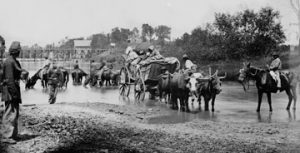
While black people were not welcomed at the newly constructed and newly named “Fredericksburg Baptist Church,” they were explicitly monitored at their own church. First, they had to pay $500 to the all-white church, so that the FBC would allow the newly all-black congregation to establish a new constitution for its church, although it is not known when and how much of this was paid off. Additionally, the black congregation was required by law to have a white overseer present during a church service, George Rowe was the legal overseer and he required a $50 monthly fee. The black church existed in this manner until 1862 when the Civil War was taking place and “more than half of the congregation fled the degradation of slavery and racial discrimination that had prevailed in Fredericksburg.” (7)During the war years, the church did not have consistent Sunday service because members had either fled, been taken by their enslavers, or the general instability of war did not make service possible.
![Pictured here is a festive outdoor service of worship and thanksgiving held in June 1890 to mark the laying of a cornerstone for construction of [Shiloh Baptist Church (Old Site)]](http://fhm.umwhistory.org/wp-content/uploads/2018/04/cornerstone-laying-1890-for-history-overview-300x204.jpg)
Shortly after the end of the Civil War, on December 24, 1866, the church had its first post-war program, a Christmas Eve celebration. In the years to come, the church continued to grow in size and even “obtained a $400 grant from the Freemen’s Bureau,” to renovate the infrastructure since it had been badly damaged during the war. (9) However, the church continued to need repairs, and in the early 1880s the pastor Willis Robinson raised $1,500 to do so, “but the deacons of the church voted to postpone action until the full amount needed could be raised.” (10)
Before that time could come, on June 11, 1886, the rear wall of the church fell, requiring demolition of the entire building. In the year following, “a deep division emerged within the congregation,” wherein reconstruction of the church was planned to be built on new property but, “others insisted on rebuilding on the original location.” (11) By late May 1887 people in favor of the relocation began meeting in the new property that was bought, while those against relocation continued to do service at the courthouse. In June 1887, “legal questions concerning title for the new property arose,” because both locations thought themselves rightful to the name. (12) The conflict ended in a compromise on November 30, 1888, when a local judge allowed both sides to keep the name with the addition of “Old Site” and “New Site,” to the end of the title.
(1) “National Register of Historic Places Program: Shiloh Baptist Church (Old Site),” National Park Services. Accessed: April 16, 2018.
(2) “A History of the Fredericksburg Congregation That Became Shiloh Baptist Church (Old Site),” Shiloh Old Site Org. Accessed: April 16, 2018.
(3)”A History of the Fred.”
(4)”A History of the Fred.”
(5)”A History of the Fred.”
(6)”A History of the Fred.”
(7)”A History of the Fred.”
(8)”A History of the Fred.”
(9)”A History of the Fred.”
(10)”A History of the Fred.”
(11)”A History of the Fred.”
(12)”A History of the Fred.”
(13)”A History of the Fred.”